
Of Objects and Onsets: Two Mycenaean Craft Terms and What They Tell Us About Greek Syllables
”Festlig Faglig Fredag” with Paolo Sabattini.
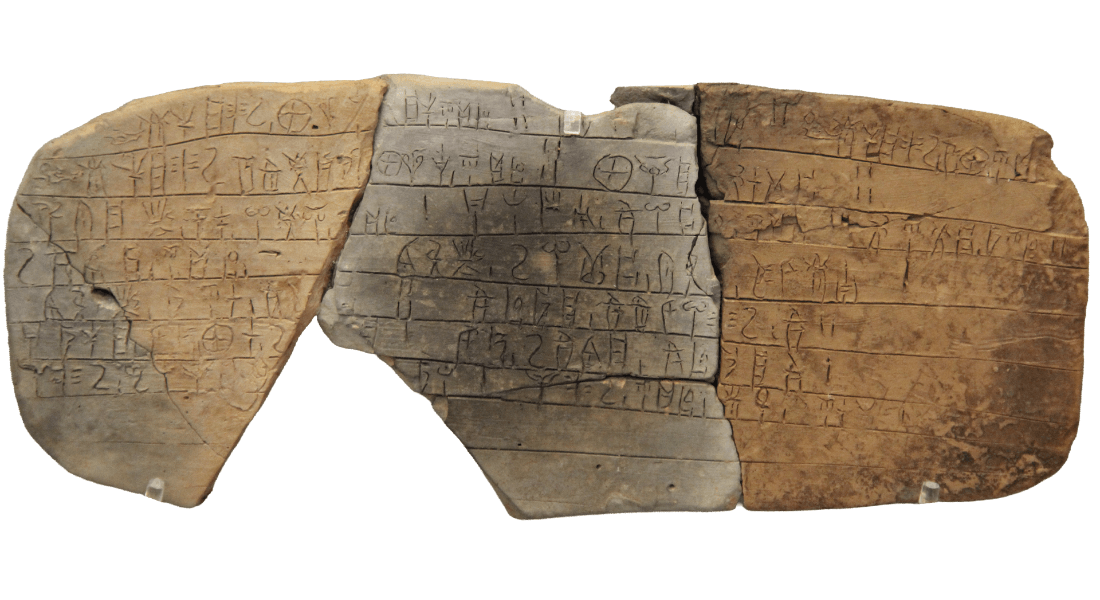
We are pleased to announce that this Friday lecture will be given by Paolo Sabattini who is a PhD Student at the Program in Indo-European Studies at the University of California, Los Angeles. As always, everyone is welcome to join from 4 o’clock, and the talk will begin at a quarter past. After the talk, everyone is also invited to stay for a refreshment.
Abstract
How many legs did Mycenaean tables have back in the Late Bronze Age? What do Mycenaean chariot wheels have in common with the shields sung in the Greek epics? How should Indo-Europeanists reconstruct Greek syllable structure and its prehistory? Believe it or not, it is impossible to answer any of these questions in isolation.
This talk discusses two technical terms attested in Mycenaean—the earliest known form of Greek (ca. 1400–1200 BCE), written in the Linear B script—and the implications of their etymological and morphological interpretation for Greek phonology. One is the Mycenaean word for ‘table’, to-pe-za /torpedᶻa/ (cf. alphabetic Greek τράπεζα ‘table’); the other is an adjective denoting chariot wheels ‘with wedges’ securing the spokes, te-mi-dwe /termidwen/ (cf. Epic τερμιόεις ‘edged (shield)’.
I argue that both terms offer insights into sound changes best understood as driven by syllable structure. In particular, I suggest that Mycenaean to-pe-za goes back to the numeral root for ‘three’, reflecting an earlier meaning ‘three-footed’, and that the same formation of Mycenaean te-mi-dwe, with an id-stem base, is the precursor of τερμιόεις in the Epic tradition.
Beyond the philological domain, these interpretations align with broader tendencies in both Mycenaean and Homeric Greek, especially two types of vowel epenthesis arguably sensitive to syllable structure: the “vocalization” of inherited syllabic liquids, and the so-called “linking vowels”—inserted between consonant-final stems in compounds and derived forms (e.g., πυρ-ο-βόλος ‘fire-darting’). Taken together, these cases show how even highly specialized vocabulary can shed light on the history and prehistory of Greek phonology.
Map of South Campus
View directions.
View on map of the Faculty of Humanities - South Campus.
View map of South Campus (pdf).